
Renovate Vs Relocate for Growing Businesses
Growing firms face a choice between renovating and relocating. Riley Riley Construction assesses cost time and business disruption for both options. Call 17207828897 to receive a tailored feasibility study. We highlight the option that supports growth with minimal downtime.
Introduction: Why the decision matters for growing businesses
For expanding companies, the choice to renovate vs relocate for growing businesses is more than an operational preference - it can shape growth trajectories, employee satisfaction, and cash flow for years. Renovation can unlock additional capacity within a familiar location, while relocation can open new markets, provide improved layouts, or secure long-term real estate advantages. Each path carries distinct cost profiles, timeframes, and degrees of business disruption that deserve careful evaluation.
Riley Riley Construction helps leaders translate strategic goals into a practical, data-driven choice. We combine cost estimates, timeline planning, tenant/landlord negotiations, and disruption mitigation strategies into a concise feasibility study so you can proceed with confidence. If you want a fast assessment tailored to your space and business model, call 17207828897 for a personalized quote.
Key factors to weigh: cost, time, disruption and strategic fit
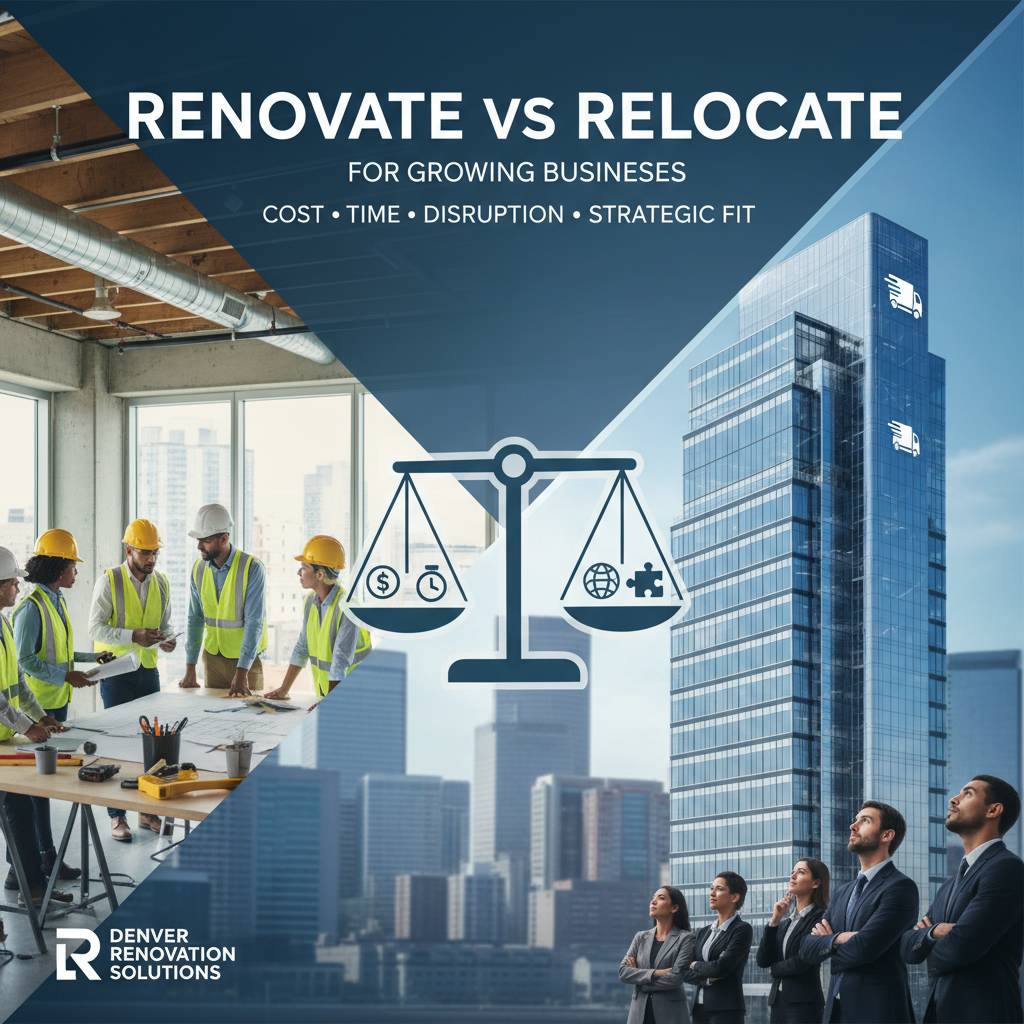 Start with the big levers: budget, timeline, and acceptable levels of disruption. Renovation generally requires capital for construction and services, possibly phased to protect operations, while relocation incurs moving costs, lease termination or new lease commitments, and onboarding expenses. Time is equally important: a minor renovation might take weeks; a full relocation can take months. Understanding the acceptable trade-offs for your firm is essential.
Strategic fit matters as much as dollars. Ask whether the existing location supports future hiring, client access, and logistical needs. If market proximity, transit access, or branding benefits are significant, relocation may unlock value that outweighs upfront costs. When making this assessment, factor in lease lengths, renewal options, potential rent escalations, and the availability of suitable spaces in your target area.
Cost drivers to analyze
- Construction and materials for renovation: partitions, MEP upgrades, finishes.
- Professional services: architects, engineers, permitting, and interior designers.
- Moving costs: logistics, IT migration, and commercial movers.
- Lease-related fees: security deposits, brokers' fees, tenant improvement allowances, and penalties for early termination.
- Downtime expenses: revenue loss, productivity impacts, and overtime to meet deadlines.
Renovation deep dive: benefits, typical costs, and managing disruption
Renovation is often the quickest way to increase capacity without changing location. You can reconfigure floor plates, add collaborative zones, upgrade HVAC and power for higher density, or implement new security and amenities to improve retention. Renovations are especially attractive when your current lease terms are favorable or when customers and employees value the current site for convenience or brand recognition.
Costs for renovation vary widely by scope and market. Minor cosmetic updates can range from $75-$200 per square foot, while comprehensive reworks that relocate structural elements and major building systems can be $150-$400 per square foot or more. These ranges depend on local labor rates, material choices, and whether upgrades trigger code compliance costs for HVAC, accessibility, or fire systems.
Downtime during renovation can be managed through phased work, night-and-weekend schedules, and temporary relocations within the same building. Expect short-term operational friction even with careful planning: noise, restricted access, and intermittent service interruptions are common. Effective stakeholder communication, contingency scheduling, and protective measures for critical operations are non-negotiable.
When renovation typically wins
- You have a long-term lease or own the property and can amortize improvements.
- The site's location is strategically important for clients or employees.
- Incremental space gains satisfy near-term headcount growth without structural overhaul.
- Renovation triggers tenant improvement allowances that reduce net cost.
Relocation deep dive: when to move and how to plan for minimal downtime
Relocating can unlock capabilities renovation cannot: better floor efficiency, improved natural light, upgraded building systems, or a different neighborhood that aligns with talent pipelines. However, moving is a project with many moving parts - site selection, lease negotiation, build-out or tenant improvements at the new space, and the logistics of physically moving people and equipment. Timing and sequencing are the keys to keeping downtime to a minimum.
Relocation costs include new lease commitments, broker fees, tenant improvements, moving expenses, signage, and often dual rent for a period when both properties are held concurrently. Moving a mid-sized office often involves $10,000-$100,000 depending on distance and complexity, and tenant improvement packages commonly fall in the same $75-$400 per square foot range as renovation depending on finish level and mechanical upgrades.
To minimize disruption during relocation, develop a phased move plan, pilot critical system transfers, and maintain parallel operations where possible. An IT cutover window, staged furniture deliveries, and advance staff training on the new layout reduce confusion and lost productivity. Communicate timelines to clients and suppliers and plan buffer days for unexpected delays.
When relocation typically wins
- Your current site has limited expansion potential and rising occupancy costs.
- Access to talent, proximity to clients, or better transit and parking are strategic priorities.
- Long-term financial benefits from lower rent or ownership outweigh short-term move costs.
- Relocation offers superior configuration that materially improves workflow efficiency.
Comparison: concrete metrics to guide the decision
 Make the choice between renovate vs relocate for growing businesses by quantifying impacts across several metrics: total cost of ownership over a 5- to 10-year horizon, projected downtime and revenue loss, employee retention risk, and the intangible benefits of brand and client perception. Use sensitivity analysis to understand how variable costs - like construction overruns or market rent increases - affect the outcome.
| Metric | Renovation | Relocation |
|---|---|---|
| Typical timeline | Weeks to months (phased) | Months to a year (site selection build-out) |
| Average cost range | $75-$400 per sq ft depending on scope | $75-$400 per sq ft for TI moving costs $10,000-$100,000 |
| Disruption level | Moderate; can be phased | High short-term; reduced once moved |
| Strategic upside | Improved utilization of existing location | Access to new markets, talent, and long-term cost savings |
Use this table as a starting point in your decision model, but adapt values to your market and business specifics. For instance, in tight urban markets renovation costs may spike due to access and staging constraints, while suburban moves may have lower moving costs but higher transportation impacts for staff.
Step-by-step decision framework
- Define strategic objectives: headcount projections, geographic priorities, and service-level requirements.
- Gather baseline data: current lease terms, maintenance history, and utility capacities.
- Estimate direct costs for both options including professional fees and contingency of 10%-20%.
- Model indirect costs: downtime, productivity loss, and potential churn of employees or clients.
- Run a 5- to 10-year cash flow analysis to capture long-term value differences.
- Assess operational risk and create mitigation plans for the chosen path.
Implementation best practices and real-world example
Whether you renovate or relocate, execution discipline determines outcomes. Start by appointing a cross-functional steering team that includes operations, IT, HR, finance, and facilities. Set clear milestones, hold weekly check-ins with contractors, and maintain an issues log that tracks impacts and resolutions. Pre-move rehearsals for IT and critical business functions reduce surprises on the go-live date.
Here is a condensed case study: A regional consulting firm with 120 employees faced capacity constraints and rising downtown rent. Riley Riley Construction conducted a feasibility study and found renovating the current footprint would deliver only a 10% capacity increase at a higher per-square-foot cost, while relocating to a nearby building provided a 35% capacity gain with similar upfront costs and lower long-term rent escalation. The company chose relocation, staged the move over two weekends to avoid client disruption, and realized a faster hiring pace in the following 12 months. This example illustrates how the right analysis reveals the option that minimizes downtime while aligning with growth objectives.
Common pitfalls to avoid
- Underestimating soft costs like internal staff time, lost opportunities, or morale impacts.
- Skipping user engagement: failing to solicit employee input can lead to low adoption of new layouts.
- Neglecting regulatory and code triggers that can add unexpected scope and expense.
- Rushing IT migration without backups and rollback plans.
Financial planning, contracts, and negotiation tips
Financial clarity reduces risk. Build a detailed budget that separates hard costs, soft costs, and contingencies. For renovations, negotiate tenant improvement allowances and staggered payment schedules tied to milestones. For relocations, secure flexible clauses in the new lease where possible - for example, options to expand, sublease terms, or abatement periods during build-out. Work closely with an experienced broker and legal counsel to avoid costly lease commitments and to understand landlord responsibilities for common-area maintenance.
When estimating return on investment, include productivity gains from better layouts or upgraded technology and factor in likely attrition costs if the new site is less convenient for staff. Use conservative scenarios in financial models to guide a risk-aware decision. For capital budgeting, consider financing options or phased implementation to spread cash requirements over time.
Final checklist and how Riley Riley Construction can help
Before committing, run through this practical checklist: Have you quantified all direct and indirect costs? Have you validated timelines with contractors and IT? Do you have a phased plan to maintain client service levels? Is employee communication planned and tested? Addressing these items early reduces surprises and helps ensure whichever option you choose supports growth with minimal downtime.

Riley Riley Construction provides tailored feasibility studies that translate these questions into actionable recommendations. Our assessment includes a line-item cost comparison, a realistic timeline with contingency planning, and a disruption mitigation strategy customized to your operations. If you would like a clear recommendation that balances fiscal prudence and strategic growth, reach out and let us prepare a concise study for your leadership team.
Call 17207828897 to schedule your feasibility study.
Ready to move forward, ask for a phased timeline and a pilot migration plan to test assumptions in a controlled way. Whether you choose to renovate or relocate, careful planning and experienced support make the difference between a painful disruption and a smooth growth milestone. Contact Riley Riley Construction at 17207828897 to get started.