
Commercial Renovation Contractor Vs Design-Build Firm
Choosing the right delivery method affects cost control and responsibility. Riley Riley Construction explains when a contractor model or design build is the better fit. Call 17207828897 to review pros and cons for your project. We help owners select the approach that reduces risk.
Selecting between a traditional contractor model and a design-build firm is one of the most consequential decisions an owner makes for a commercial renovation. The choice shapes who controls budgetary decisions, who carries the schedule risk, and how responsibilities are divided across design and construction. Riley Riley Construction helps owners weigh the trade-offs so they can pursue an approach that matches project complexity, timing pressure, and tolerance for shared versus single-party responsibility.
When owners call 17207828897 we review core priorities-cost certainty, design control, single-point accountability, and schedule compression-and map them to delivery options. The phrase commercial renovation contractor vs design-build firm often frames initial conversations, but the deeper questions probe risk allocation, procurement preferences, and how early contractor input should shape design decisions. This guide outlines practical signals that point to one model over the other and provides an actionable evaluation checklist for owners.
Understanding the contractor model and the design-build approach
The contractor model (often called design-bid-build) keeps design and construction contracts separate: an owner hires an architect to complete construction documents and then solicits competitive bids from general contractors. That separation preserves strong owner oversight of design decisions and clear scopes during bidding, but it can also create adversarial dynamics when scope gaps or unforeseen conditions arise during construction.
Design-build consolidates responsibility with a single firm or joint venture that handles both design and construction under one contract. This arrangement enables earlier contractor input on means, methods, and cost-saving opportunities and typically shortens the overall schedule through overlapping activities. The trade-off is that owners cede some direct control over design decisions and rely on contractual protections and oversight to ensure design intent and quality.
Both delivery methods can deliver excellent results when matched to project characteristics and governance: the commercial renovation contractor vs design-build firm decision is less about absolutes and more about aligning incentives, timing, and ownership appetite for design oversight versus single-source accountability.
How cost control and responsibility differ between the two models
 Cost certainty is often front-and-center for owners. In the contractor model, owners can obtain competitive lump-sum bids that reflect full construction documents, which improves baseline budget confidence if the design is complete and well-coordinated. However, because contractors price a degree of risk into bids for unknowns and because design omissions become change orders, the final cost can shift during construction without strong contingency management.
Design-build offers potential for earlier cost certainty because the same team aligns design decisions with construction means and budget targets from the outset. Owners can pursue guaranteed maximum price (GMP) arrangements that transfer the downside of cost overruns to the design-builder, but they must be rigorous during negotiated scopes and contingencies. The single contract simplifies claims and point-of-contact issues, which reduces administrative burden but requires trust in the design-builder's cost transparency.
Responsibility and liability also diverge. With separate contracts, the owner acts as the intermediary when disputes arise between architect and contractor, which can increase project friction and extend dispute timelines. Design-build centralizes accountability: the design-builder is contractually responsible to the owner for both design performance and construction delivery, streamlining claim resolution but also concentrating risk with one entity.
When a commercial renovation contractor model is the better fit
Choose the contractor model when design detail and architectural control are top priorities. If your project demands precise aesthetic outcomes, strict code interpretation, or phased tenant work that relies on detailed construction documents, the design-bid-build route preserves the owner's ability to direct a fully developed design before awarding construction. This approach is particularly well-suited for projects where the owner wants multiple competitive bids to drive pricing and demonstrate market value.
Other signals pointing toward a contractor model include relatively simple procurement rules or funding sources that mandate competitive bidding, and situations where the owner has internal construction management capability to administer separate contracts. If the owner wants distinct points of negotiation with an architect and a contractor, or plans to perform significant owner-supplied scope, keeping contracts separate may reduce conflicts of interest.
Typical project examples that often favor a contractor model are faade restorations with strict preservation requirements, tenant finish packages where design must match existing corporate standards exactly, and municipal projects with fixed procurement policies. In each case, detailed documents, competitive pricing, and clear boundaries of responsibility provide the control owners need.
When a design-build firm is the better fit
Design-build frequently shines when schedule compression, early contractor input, and cost collaboration are priorities. If your renovation needs to be completed on a tight calendar or with minimal disruption to operations-such as an occupied hospital wing or an active retail store-integrating design and construction teams can accelerate delivery through phased permitting, early procurement of long-lead items, and constructability-driven design adjustments.
Design-build also benefits projects with significant unknowns where contractor expertise can materially reduce risk. For example, adaptive reuse projects or complex MEP integrations often require trade-off decisions between preserve-or-replace strategies; a design-build team can rapidly evaluate alternatives and implement the most economical pathway. The single-contract model reduces adversarial interactions and aligns incentives toward cost-effective problem solving.
If you prefer a single point of contact and want to minimize claims and finger-pointing during construction, design-build is compelling. It is particularly effective for owner teams that place high value on collaboration and are comfortable with less direct design ownership, provided contractual safeguards ensure acceptable quality and performance levels.
Side-by-side comparison
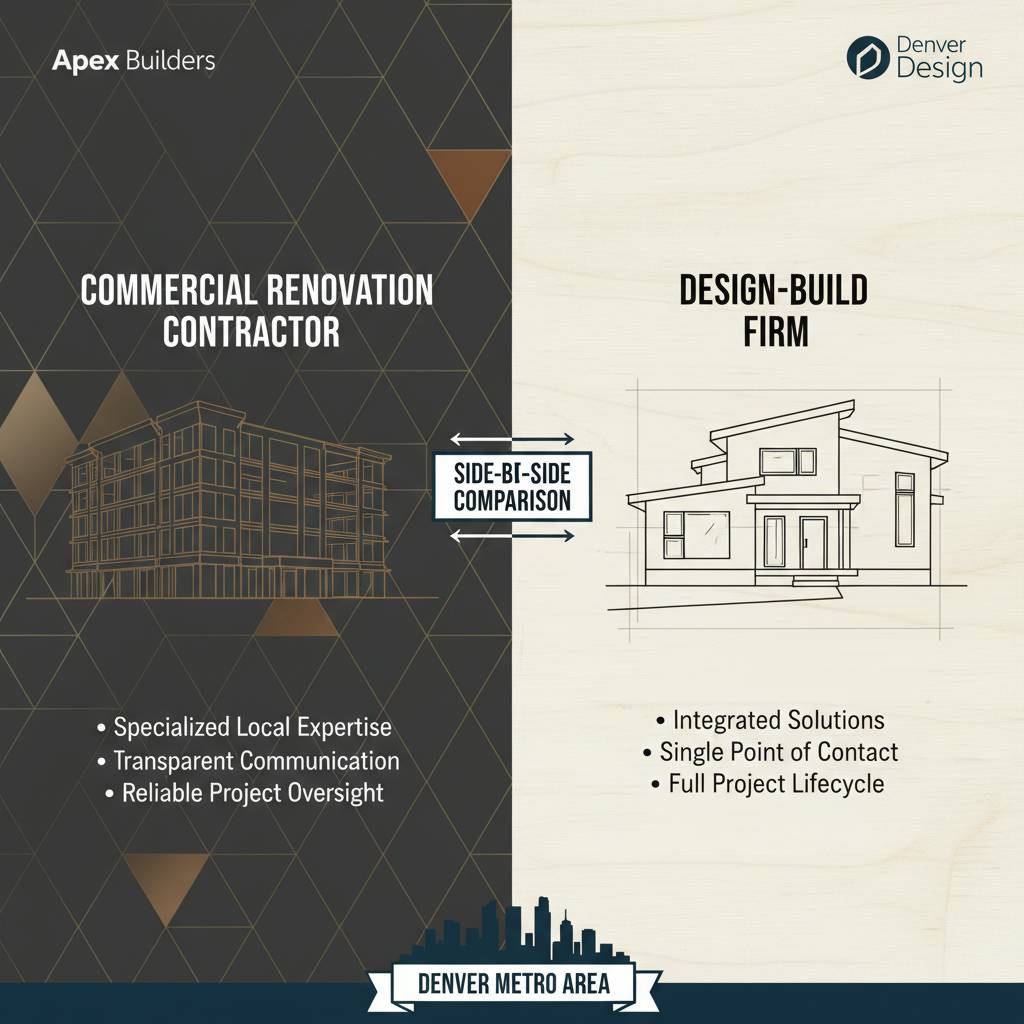 When weighing the commercial renovation contractor vs design-build firm options, a side-by-side lens clarifies how key attributes differ in practice. Below is a concise comparison of primary considerations owners use to evaluate delivery method suitability. Use this table as an initial diagnostic; each project's specifics can shift the preferred approach.
| Attribute | Contractor Model (Design-Bid-Build) | Design-Build |
|---|---|---|
| Contract Structure | Separate contracts for design and construction | Single contract covering design and construction |
| Cost Control | Competitive bids can lower price; change orders may increase cost | Early contractor input helps align design to budget; GMP possible |
| Schedule | Sequential phases; longer overall timeline | Overlapping phases enable faster delivery |
| Risk Allocation | Owner mediates disputes; risk split across parties | Single-party responsibility simplifies claims |
| Design Control | High owner and architect control | Owner cedes some direct control; collaborative design |
| Typical Projects | Historic preservation, strict architectural standards | Fast-track renovations, adaptive reuse, complex MEP |
| Estimated Construction Cost Range | $75-$200 per square foot (highly variable by scope) | $85-$220 per square foot (reflects integrated services) |
Note: cost ranges are illustrative and depend on project size, market conditions, and scope. Owners should treat these figures as starting points and request detailed proposals with market-specific data for final budgeting.
How to choose: practical evaluation steps
Start with a frank assessment of priorities. List your top three objectives-whether that is absolute cost minimization, precise design fidelity, the shortest possible timeline, or reduced administrative burden. Map each objective against the delivery model attributes discussed earlier, then weigh which trade-offs are tolerable. This focused approach reduces the noise of marketing claims and clarifies which method aligns best with core project goals.
Next, vet firms for demonstrated experience on similar projects. For a contractor model, evaluate general contractors' bid accuracy history and the architect's ability to produce fully coordinated documents. For design-build, assess the team's integrated track record, how they manage subcontractor selection, and their approach to GMPs or open-book pricing. Ask for references and performance metrics such as schedule variance, change order frequency, and warranty claims.
Use a simple procurement checklist to structure comparisons: clarify scope, request sample contracts, require transparency on contingency allocation, and insist on clearly defined change management procedures. If you engage multiple teams for proposals, provide the same baseline information so bids are comparable. When appropriate, consider a two-stage procurement that combines early contractor engagement for pricing guidance with later competitive pricing for remaining work.
Questions to ask potential partners
- Can you share comparable project references and documented outcomes?
- How do you price contingencies and how are change orders handled?
- What is your approach to schedule compression and phasing in an occupied building?
- How do you ensure design quality while meeting budget targets?
- Will you provide open-book cost reporting or a fixed GMP?
Answers to these questions reveal culture and process as much as technical capability. A team that openly shares past performance and walks through trade-offs demonstrates the transparency owners need to make confident decisions.
Frequently asked questions and a brief case example
FAQ: "If a project has uncertain existing conditions, should I choose design-build?" Uncertainty favors early contractor involvement; design-build typically reduces risk by letting the team innovate in real time and price unknowns within a broader contractual framework. However, if the owner requires maximum design control despite uncertainty, a contractor model with negotiated allowances can still work, provided the owner accepts potential change orders.
FAQ: "Does design-build cost more?" Not inherently. Design-build can cost less overall when early constructability input eliminates expensive mid-construction rework and when the team is aligned on budget targets. Conversely, a weakly structured design-build contract without clear price accountability can permit cost drift, so procurement discipline is essential.
Case example: A regional healthcare provider needed to renovate an active outpatient wing within a 12-week shutdown window. The owner selected a design-build firm that phased design and prefabricated major MEP assemblies while construction crews completed sequential zones overnight. The integrated approach delivered on time and reduced expected overtime and rework costs compared to initial separate-bid estimates, demonstrating how delivery selection directly impacts schedule and cost outcomes.
Next steps and how Riley Riley Construction can help
If you are evaluating the commercial renovation contractor vs design-build firm question for an upcoming project, start with a short discovery call so we can align on priorities, schedule constraints, and risk tolerance. Riley Riley Construction offers a practical, impartial assessment that outlines which delivery method better matches your objectives and the likely financial and schedule implications of each path.
We can prepare a concise decision memo, an evaluation checklist, and a recommended procurement strategy-whether that means preparing a tight design-bid package or scoping an RFP for a design-build team with clear GMP expectations. For owners who prefer hands-on help, we can manage the procurement process, vet teams, and assist in contract negotiation to ensure responsibilities and contingencies are explicit.
Call 17207828897 to schedule a review of your project's delivery options. Our team will help identify the approach that reduces your risk and supports your business objectives.
Thank you for considering Riley Riley Construction. We look forward to helping you choose the method that best controls cost, clarifies responsibility, and delivers the renovation outcome you expect. Contact us at 17207828897 for a practical, project-specific consultation.